Skill
I run Open Claw on a Raspberry Pi. It costs almost nothing — maybe a few dollars a month in electricity — and it is always on, always listening in Discord. The one time cost of Pi is equivalent a months of hosting in the cloud.
(Of course tokens are another story — I run Open Claw with Claude Sonnet and it is very impressive, but costly. Any frontier model, including Gemini or ChatGPT should be sufficient though.)
Discord always with me on iPad or a phone. That is the setup.
The interface
Discord turns out to be a good interface for an agent that lives alongside your life. I have a main channel for general conversation — asking questions, thinking out loud, getting nudges. Then I have a separate project channel for each thing I am working on including the People App. The agent knows the context of each channel and responds accordingly.
How I actually use it
I do not try to give the agent everything upfront. No calendar access. No email. I can manage both of those perfectly well with the normal UI, and I do not see the point of overcomplicating it.
What I do give it is a conversation about people.
The starting point is simple: I talk about the 50 or so people I have messaged recently. The skill I created runs the search first to fill in context. Then I just describing people — how I know them, what they are working on, what we talked about last.
That conversation is already useful. Patterns start emerging. You elaborate and reflect.
From there, I naturally extend to people I have not talked to in a while but keep thinking about. Interesting people who have dropped off the radar. Former colleagues. Old friends. The agent helps me to build a complete database.
Going with the flow
One thing I learned: do not try to build the whole map at once. Let it grow naturally.
During the day I meet people — in calls, at events, in passing. I add them as I go. A quick message: "just met someone called Priya, she runs ops at a climate logistics startup, introduced through Rahul." That is enough. The agent adds it to the picture.
Over a few weeks, you end up with something surprisingly rich — not because you worked hard on it, but because you were just talking.
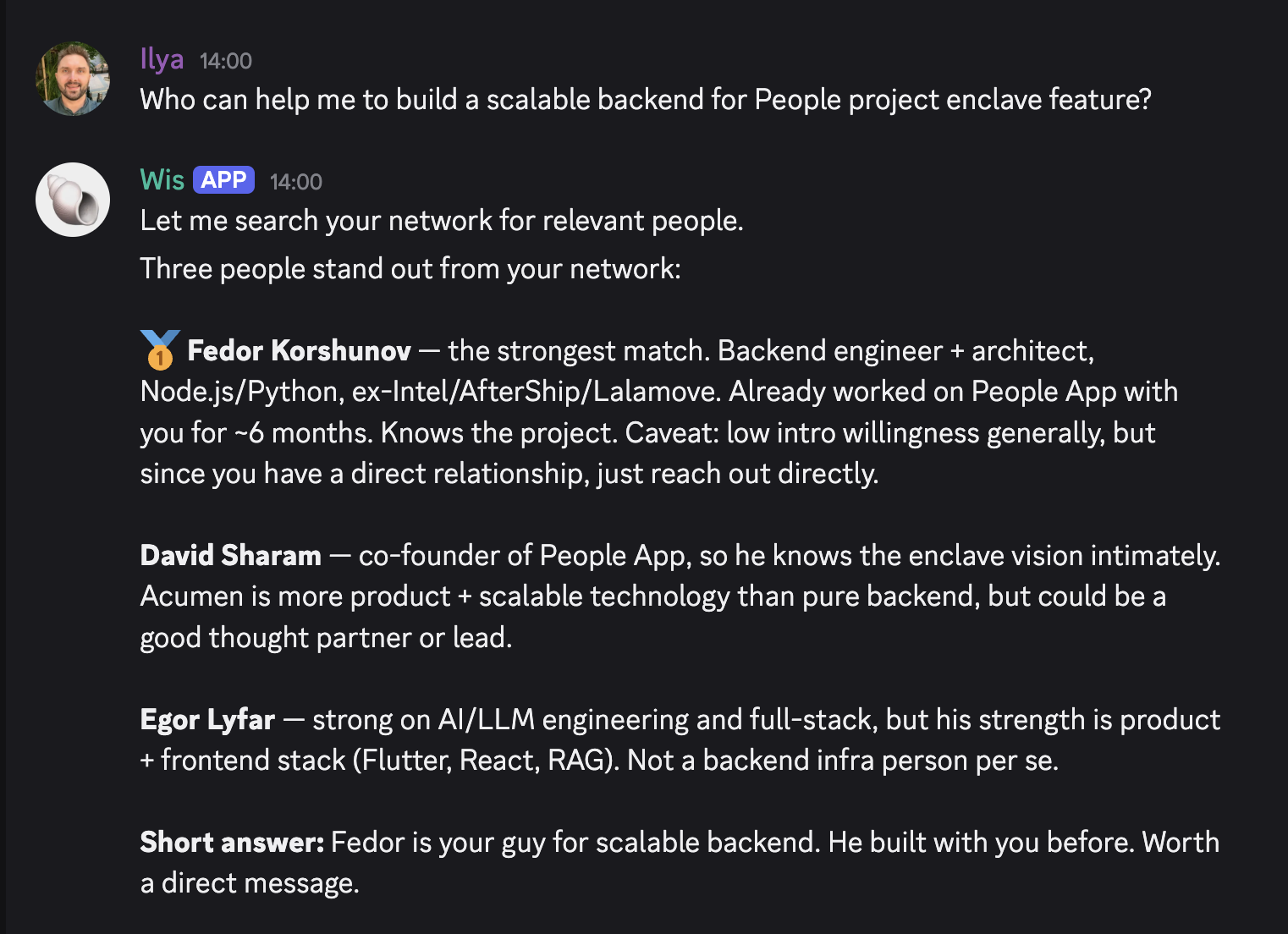
Once you built a people data set you can ask your data:
Patterns and coaching
The part that surprised me most is how much value comes from the pattern-spotting.
When you talk about people with an AI that is tracking context across conversations, it notices things you genuinely miss. Someone you keep mentioning but never actually reaching out to. A cluster of people in the same space who do not know each other yet. Someone who said something six months ago that is suddenly relevant.
It makes suggestions. Most of them are good. A few are obvious. Occasionally one stops you in your tracks.
If you already use AI as a coach or a thinking partner, this is a natural extension of that habit — applied to your relationships. And the act of talking about people is, in itself, a positive experience. It is not transactional. It feels more like catching up with yourself.
What this is not
It is not a CRM. It is not a replacement for your contacts app or your calendar. It is not LinkedIn (phew). It does not need to be connected to everything or drive engagement.
It is closer to having a patient, context-aware conversation partner who knows your people and helps you connect deeper.
What next
Next, we are building a way to scale this approach where you will be able to find connections of your trusted friends peer-to-peer.
Imagine how much wider you may reach if you are not only talking to your contacts, but to the contacts of all your trusted friends. This may change your reach fundamentally.
Want to set this up yourself? Start with OpenClaw and the Know Your People skill. The skill install takes about 30 seconds!